
China Top Fog Fountain Suppliers for Global Buyers?

China Top Fog Fountain Suppliers for Global Buyers? This question deserves more than a factory list. It requires evidence, technical judgment, and careful supplier verification. A Fog Fountain combines water treatment, high-pressure nozzles, lighting, controls, and architectural coordination. Each component affects safety, maintenance, and visual quality.

Demand is closely linked to public spaces, hospitality, and tourism development. UN Tourism reported approximately 1.4 billion international tourist arrivals in 2024, reaching about 99% of 2019 levels. This recovery increases pressure on resorts, shopping districts, museums, and civic plazas to create memorable visitor experiences. The World Bank’s urban development research also highlights the growing importance of attractive, inclusive public spaces. Mist-based installations can support that goal, but only when humidity, wind, drainage, and pedestrian movement are properly assessed.

Details matter.

Professional buyers should examine pump brands, nozzle materials, mist particle size, control protocols, water recycling design, and spare-parts availability. ISO 9001 certification may indicate process discipline, yet it does not prove project competence. Requesting factory videos, engineering drawings, test records, and references from comparable climates is more reliable. A supplier should explain cleaning intervals and failure responses clearly.

Price alone misleads.

Some Chinese manufacturers offer strong fabrication capacity and competitive customization. Others may lack commissioning experience outside their domestic market. No supplier list is flawless. Buyers must still verify certifications, export documentation, electrical compatibility, warranty terms, and local installation support. The strongest sourcing decision balances spectacle with long-term operation, not just the first quotation.
China Top Fog Fountain Suppliers for Global Buyers?

What Is a Fog Fountain and How Does It Work?

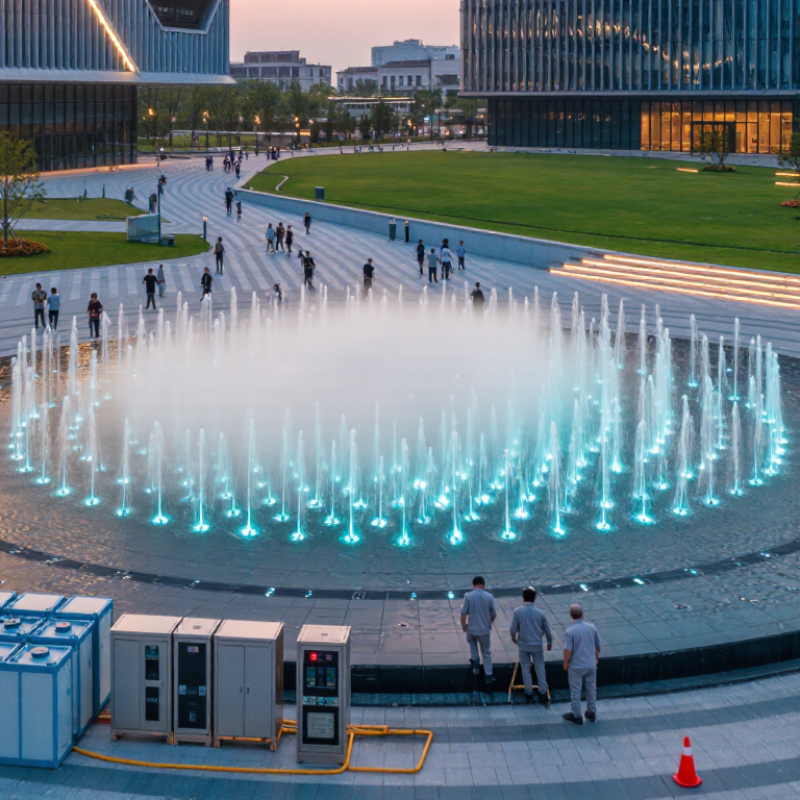
A fog fountain is a decorative water feature that produces a low, cloud-like mist above its basin. Unlike ordinary fountains, it uses ultrasonic atomizers to break water into extremely fine droplets. These droplets rise gently and interact with colored lighting, creating a floating, dreamlike effect.

The working process is simple but carefully controlled. An atomizer vibrates at high frequency beneath the water surface. This vibration creates mist without boiling the water. A small fan may guide the fog across the basin, while LEDs illuminate the moving vapor. Air temperature, water level, humidity, and airflow all affect the result. In practical installations, the fog may appear uneven, especially in dry or windy spaces. That detail is often overlooked.

Tips: Choose a supplier with clear technical drawings, tested atomizers, and accessible maintenance guidance. Ask about water-quality requirements, replacement parts, electrical protection, and expected operating hours. A reliable supplier should explain installation limits instead of promising perfect performance everywhere. Regularly clean the basin and atomizer to reduce mineral buildup. Filtered water usually helps, but it does not remove every maintenance concern. Global buyers should also verify packaging quality, voltage compatibility, safety documentation, and after-sales communication before placing a large order.

Key Features of China’s Leading Fog Fountain Suppliers

China Top Fog Fountain Suppliers for Global Buyers?

China’s leading fog fountain suppliers combine water engineering with theatrical design. Their systems often use stainless steel nozzles, ultrasonic mist units, LED lighting, and programmable control panels. Buyers should request clear data on flow rate, spray height, power demand, and operating noise. These details matter more than attractive videos.

Experienced suppliers usually provide layout drawings, nozzle samples, wiring diagrams, and factory testing records. Some can adjust mist density for indoor halls, hotel entrances, gardens, or public squares. Enclosures with suitable IP ratings protect controls from moisture. A reliable supplier also explains cleaning schedules, filter replacement, and winter storage. Ask for spare parts lists.

Not every quotation shows the full cost. Shipping, installation guidance, packaging, and remote troubleshooting may appear later. That is a weakness in many purchasing decisions. A practical evaluation should compare material thickness, pump efficiency, warranty terms, and response time. Request a sample test when possible. See the mist directly. Minor droplets may drift in strong air movement, even after careful design. Suppliers should admit this limitation and recommend drainage, ventilation, and safe walking distances. Clear technical communication builds more trust than exaggerated performance claims.

How to Compare Fog Fountain Manufacturers and Product Options

China Top Fog Fountain Suppliers for Global Buyers?

Comparing fog fountain manufacturers requires more than checking unit prices. Examine their technical drawings, nozzle layout, pump capacity, mist coverage, and water circulation design. A reliable supplier should explain how the system performs in different climates and water conditions. Ask for material details, especially for outdoor basins, pipes, and exposed fittings. Stainless steel quality matters near humid or coastal sites. It affects maintenance costs later.

Tips: Request a working video, a test report, and a spare-parts list. Confirm warranty terms, installation guidance, packaging protection, and response times before ordering. Also compare energy use, noise levels, cleaning access, and control-system compatibility. These details often separate a workable fountain from an attractive but difficult installation. A sample test is useful. Photos can hide uneven mist, weak lighting, or pump vibration.

Product options should match the project, not just the catalogue. A compact indoor fountain may need quiet operation and precise humidity control. A large outdoor feature may require stronger pumps, drainage planning, wind resistance, and remote controls. Ask whether the manufacturer can adjust nozzle spacing or basin dimensions. Customization sounds helpful, but it may increase lead time and replacement difficulty. A low quotation can be misleading. In practice, the cheapest option is not always the easiest to operate, and even experienced buyers can overlook after-sales support.

China Top Fog Fountain Suppliers for Global Buyers? - How to Compare Fog Fountain Manufacturers and Product Options

Practical comparison guide using typical China-based manufacturing and product ranges. Specifications, pricing, certifications, and delivery terms should be confirmed in the supplier’s current quotation.

Fog Fountain Manufacturer and Product Option Comparison
Comparison Dimension Compact Indoor / Event System Commercial Outdoor Fountain Large Custom Installation What Global Buyers Should Verify
Typical application Retail displays, exhibitions, hospitality interiors, temporary events Theme parks, hotel gardens, public plazas, restaurants, landscape projects Cultural venues, resort developments, municipal projects, permanent attractions Request reference installations with similar climate, operating hours, and visitor traffic.
Approximate fog output About 0.5–3 L/min, depending on nozzle count and pump configuration About 2–15 L/min for multi-nozzle systems 15 L/min and above; engineered to the site’s coverage and visual effect Confirm whether the figure means water consumption, rated flow, or visible fog output.
Common operating pressure Approximately 40–70 bar for fine misting configurations Approximately 50–100 bar, depending on nozzle design and desired fog density Often engineered above 70 bar, subject to pump, piping, and safety requirements Check pump rating, pressure at the most distant nozzle, relief protection, and noise level.
Nozzle and droplet specification Fine mist nozzles; commonly specified around 5–20 micrometres under test conditions Multiple anti-drip or clog-resistant nozzles; droplet size varies by pressure and water quality Project-specific nozzle layout, zoning, filtration, and control strategy Ask for nozzle material, spray-angle data, anti-drip performance, and replacement availability.
Water treatment and filtration Basic sediment filtration; soft or filtered water is usually recommended Multi-stage filtration is commonly required to reduce nozzle blockage and scale May include automatic flushing, water treatment, dosing, and water-recovery systems Confirm maximum TDS, hardness limits, filter micron rating, drainage, and cleaning intervals.
Control options Manual switch, timer, basic remote control, or simple sensor Programmable controller, DMX compatibility, wind sensor, and zone control may be available Integrated PLC, show control, weather sensors, remote monitoring, and custom interfaces Verify communication protocols, software ownership, remote-access security, and local support.
Electrical configuration Commonly 110–120 V or 220–240 V, single-phase, subject to destination market Single-phase or three-phase power; voltage and frequency must be specified before production Engineered electrical cabinet with site-specific load calculations and protection Confirm voltage, frequency, phase, IP rating, grounding, overload protection, and local code compliance.
Enclosure and material options Powder-coated steel, stainless steel, or compact polymer enclosures Typically stainless steel or corrosion-protected metal for outdoor use Marine-grade stainless steel, custom frames, concealed pipework, and architectural finishes Request material grade, coating thickness, corrosion test information, and enclosure ingress protection.
Indicative manufacturing lead time About 15–30 working days after payment and specification approval About 30–60 working days, depending on customization and testing Approximately 60–120 or more working days for engineering, fabrication, and factory testing Separate design approval, production, inspection, export packing, and shipping time in the schedule.
Minimum order quantity Often one complete unit for standard models Often one project set; replacement parts may have separate minimum quantities Project-based; quantity is normally determined by site design and bill of materials Confirm whether samples, spare nozzles, filters, and control cabinets are included in the quoted quantity.
Quality and compliance documents Electrical test report, user manual, packing list, and applicable conformity documents Factory test records, wiring diagrams, material details, and destination-market documentation Approved drawings, risk assessment, factory acceptance test, commissioning documents, and maintenance plan Check document validity, testing scope, destination-country requirements, and whether certificates cover the supplied model.
Packaging and export handling Export carton or plywood crate, depending on weight and transport mode Moisture protection, shock protection, labeled components, and reinforced export packing Crated modules with lifting points, marked connection points, and installation documentation Confirm crate dimensions, gross weight, HS classification, shipping terms, and responsibility for customs clearance.
After-sales service Remote troubleshooting, spare-part supply, and basic operating instructions Commissioning guidance, maintenance schedule, replacement parts, and technical support Site engineering, commissioning, operator training, preventive maintenance, and service-level arrangements Compare warranty duration, response time, spare-part prices, training scope, and local service capability.
Buyer evaluation rule: Compare suppliers using the same water quality, nozzle quantity, operating pressure, electrical configuration, control system, packaging method, delivery term, warranty scope, and installation requirements. The lowest equipment price may not represent the lowest total cost of ownership.

Quality Standards, Customization, and Export Capabilities

China Top Fog Fountain Suppliers for Global Buyers?

Quality Standards, Customization, and Export Capabilities

Reliable fog fountain suppliers usually begin with measurable quality controls. Buyers should request stainless steel grade records, pump performance data, nozzle tolerances, and electrical safety documentation. Factory inspections can reveal details that brochures often miss, such as uneven welding or poorly sealed cable joints. Small defects become expensive after installation.

Customization should match the project environment, not only its visual concept. Suppliers may adjust fountain diameter, fog density, lighting color, control systems, and water circulation design. They should also calculate power requirements for the destination site. A coastal installation needs stronger corrosion protection. An indoor display may require quieter pumps and improved humidity control. Test samples help, although one sample cannot represent every production batch.

Export capability involves more than loading equipment into a container. Experienced suppliers prepare accurate packing lists, wiring diagrams, installation instructions, and spare-parts recommendations. Crated pumps and fragile nozzles need moisture protection and shock-resistant packaging. Confirming voltage, frequency, plug standards, and local certification requirements prevents avoidable delays. Some suppliers communicate well before payment, then respond slowly during installation. That risk deserves direct questions and written service commitments. No supplier is perfect, and buyers should verify claims through factory audits, production photos, independent inspections, and references from comparable projects.

China Fog Fountain Suppliers for Global Buyers: Quality, Customization and Export Readiness

IEC 60529 water-ingress protection levels commonly considered when specifying outdoor fog fountain components.

Higher IPX ratings indicate stronger protection against water exposure, from splashing at IPX4 to continuous immersion conditions covered by IPX8. Global buyers should request applicable test reports, confirm CE, EMC and RoHS requirements for the destination market, and verify customization details such as nozzle configuration, pump capacity, lighting, control systems and packaging. Export-ready suppliers should also provide clear technical drawings, inspection records and shipping documentation.

Reference: IEC 60529, Degrees of protection provided by enclosures (IP Code). Product and market requirements may vary.

How Global Buyers Can Select the Right Chinese Supplier

China Top Fog Fountain Suppliers for Global Buyers?

Selecting a Chinese fog fountain supplier requires more than comparing catalogue prices. UNIDO’s International Yearbook of Industrial Statistics 2024 reports that China generated about 31% of global manufacturing value added in 2022. Scale helps, but it does not guarantee consistent mist output, safe wiring, or dependable after-sales support. Ask for factory videos, recent project references, ISO 9001 certificates, and test records for pumps, nozzles, lighting, and control cabinets.

Check technical details before negotiating. A reliable supplier should state nozzle flow, particle size, water quality requirements, noise level, power consumption, and operating temperature. Confirm electrical protection against moisture through relevant IEC 60529 IP ratings. Request a complete wiring diagram and spare-parts list. Small omissions become expensive overseas.

Review logistics realistically. The World Bank’s Logistics Performance Index 2023 gave China a score of 3.7, ranking it 19th globally, yet port performance and inland delivery still vary by region. Choose suppliers near suitable export hubs, then verify packaging with photographs or a pre-shipment inspection. I have seen attractive samples fail after long transport. That risk is easy to underestimate. A lower quotation may exclude drainage design, commissioning support, or replacement nozzles. Compare total delivered cost, warranty response time, documentation quality, and evidence from operating installations—not promises made during a video call.

Article Source:

Blogs